Menu
By: Vytas Norusis, MAI, Executive Vice President & National Industrial Outdoor Storage Practice Lead
Industrial outdoor storage (IOS) has moved from the margins of commercial real estate to the center of institutional investor attention. Once viewed as a fragmented collection of truck yards, contractor yards, container storage facilities, and equipment-storage sites, IOS has increasingly become a recognized institutional real estate asset class. The same characteristics that first attracted equity investors — limited supply, zoning barriers, strong tenant demand, and the difficulty of replacing well-located outdoor storage sites — are now drawing more attention from lenders.
Not long ago, IOS financing was largely a local, relationship-driven business. Lenders often underwrote a truck yard, contractor yard, container storage site, or equipment rental location as a one-off property. That approach worked when portfolios were smaller and ownership was more fragmented, but it has become less efficient as dedicated platforms assemble dozens of sites across multiple states.
As ownership has scaled, portfolio acquisitions, recapitalizations, and national operating platforms have required financing tools that move beyond the traditional property-by-property mortgage model. One emerging solution is pledge-of-equity financing. Although not yet standard across the sector, recent transactions suggest lenders are becoming more receptive to structures designed for large-scale IOS ownership.
Historically, IOS financing leaned heavily on local and regional banks. That made sense. Many properties were locally owned, tenant rosters were specialized, and underwriting required a detailed understanding of zoning, site configuration, environmental conditions, and local demand drivers.
Compared with traditional warehouse assets, IOS historically had fewer standardized underwriting benchmarks and fewer institutional transactions to point to, which helped keep financing more relationship-driven and conservative.
As ownership became more institutional, that model began to face new pressure.
That pressure coincided with a broader shift in the lender universe. Recently announced financings show debt funds, national lenders, and institutional credit providers pursuing opportunities in scaled portfolios and high quality assets in major logistics markets.
This broader lender interest has centered on several structural characteristics of IOS:
By 2026, announced transactions showed IOS financing expanding beyond its traditional local-bank base.
The following table compares announced IOS financing activity from 2025 to YTD 2026. The 2025 transactions primarily involved traditional mortgages, portfolio financings, or unsecured credit facilities, while several 2026 transactions introduced or expanded the use of pledge-of-equity structures.
| Year | Transactions | Assets | Dollar Volume ($B) |
| 2025 | 8 | 289 | $1.46B |
| 2026 | 18 | 616 | $4.02B |
| Total | 26 | 905 | $5.48B |
The data set includes 26 announced financings exceeding $75 million, totaling approximately $5.48 billion. Approximately 73% of that dollar volume occurred in 2026, highlighting the recent acceleration in large-scale IOS lending.
The transactions also show a clear structural evolution. The clearest public examples are Alterra’s two 2026 financings: its $244 million Blackstone loan and $400 million Truist/KeyBank refinancing both explicitly used pledge-of-equity structures instead of conventional property-level mortgages. By contrast, the 2025 financings in the comp set consisted of traditional mortgages, portfolio refinances, or unsecured credit facilities.
Traditional mortgages remain important to IOS financing but can become cumbersome for large national portfolios. Sponsors operating across multiple jurisdictions may face separate title work, mortgage recordings, legal opinions, and diligence requirements for each property.
Alterra IOS made that point directly in discussing its 2026 refinancing, noting that traditional mortgage structures can become time- and cost-intensive at scale. For growing operators, a structure that supports acquisitions, recapitalizations, and refinancings without reopening the mortgage process for every property can provide meaningful flexibility.
In a pledge-of-equity structure, the lender takes a security interest in the ownership interests of the property-owning entity. Typically, a parent or holding company pledges its membership interests in the borrower, creating entity-level collateral that may supplement or, in some cases, replace mortgages recorded against individual properties.
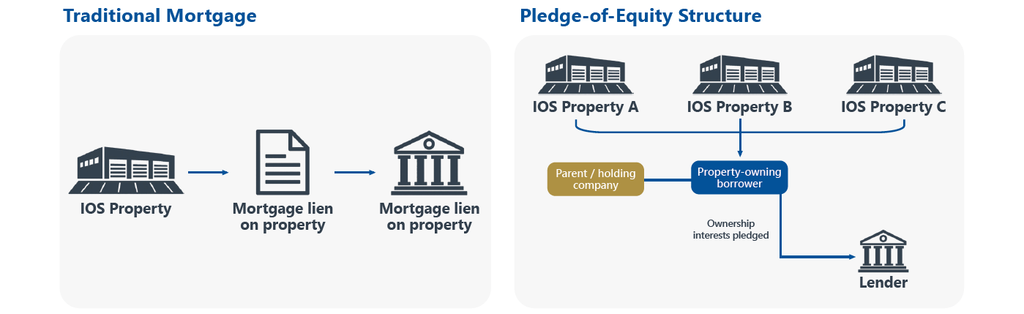
In practical terms, the lender is also looking to the ownership structure above the real estate, creating a potentially more scalable collateral framework for large portfolios when properly documented.
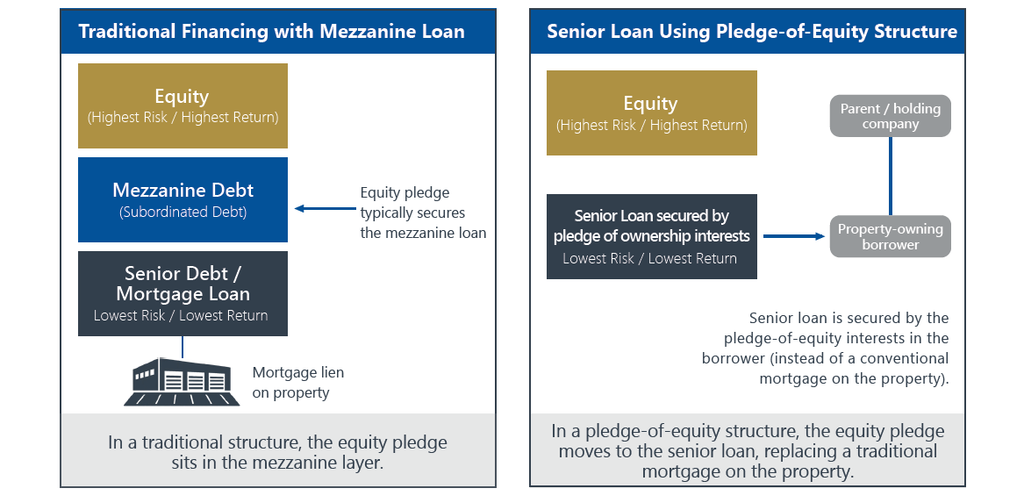
Although equity pledges are often discussed alongside mezzanine lending, they are not the same thing. In a traditional mezzanine structure, the mezzanine borrower is generally a parent entity above the mortgage borrower, and the mezzanine lender’s collateral consists of that parent’s ownership interests in the property owning mortgage borrower.
The IOS transactions discussed here are different. The pledge of equity is being used within senior portfolio-level financings rather than as a separate junior layer of debt. The goal is not to add a mezzanine slice to the capital stack; it is to create a financing structure that better fits large, diversified IOS portfolios.
Recent IOS transactions show how this can work in practice. Alterra IOS’s $244 million financing contemplated future acquisition funding, while its $400 million refinancing supported continued platform growth and refinancing objectives.
For large IOS portfolios, the primary appeal of an equity-pledge structure is flexibility. Rather than recording and releasing mortgages property by property, sponsors may be able to add, sell or recapitalize assets within a broader financing structure.
Several recent transactions show how this financing evolution is playing out in the market.
In June 2026, Alterra IOS closed a $244 million non-recourse loan from Blackstone Real Estate Debt Strategies. The financing related to an initial portfolio of 37 IOS properties across 27 markets, totaling approximately 165 usable acres and 806,000 square feet of warehouse space. Alterra publicly disclosed that the facility used an equity-pledge framework rather than traditional asset-level mortgages.
The transaction demonstrated that a major institutional lender was willing to finance a large IOS portfolio through an equity-pledge structure rather than treating each yard as a separate financing exercise.
Alterra described the approach as a more efficient and scalable way to finance institutionally owned IOS assets while maintaining core lender protections.
One month later, Alterra completed a second, larger equity-pledge financing.
The company secured a $400 million facility from Truist Financial and KeyBank covering 99 IOS properties across 27 states. The portfolio included approximately 551 usable acres and nearly 2.1 million square feet of warehouse space. Like the Blackstone financing, this facility was expressly structured through an equity-pledge framework rather than traditional asset-level mortgages
The transaction also brought the structure into the bank lending market. The earlier Blackstone transaction demonstrated private-credit acceptance; the Truist and KeyBank facility suggested that commercial banks were also willing to consider entity-level collateral structures for large, diversified IOS portfolios. According to Alterra, the structure reduced legal and administrative burden while supporting streamlined portfolio-level underwriting.
Zenith IOS provides another example of the structure’s adoption.
In August 2026, Zenith IOS closed a $215 million senior secured credit facility provided by KeyBank and Truist Financial in support of its second programmatic joint venture with J.P. Morgan Asset Management. Public announcements described a 34-property IOS portfolio totaling approximately 140 usable acres, with an accordion feature that could increase commitments to $500 million.
The public announcements did not describe the collateral structure in detail. However, a transaction participant directly involved in IOS pledge-of-equity financings confirmed that the Zenith facility utilized a pledge-of-equity structure rather than traditional property-level mortgages.
Together, the Zenith and Alterra financings illustrate how equity pledges may better accommodate IOS platforms than traditional asset-by-asset mortgages.
Industry participants have also referenced additional IOS operators that have completed similar transactions, although those financings have not been publicly disclosed in sufficient detail to independently verify their structure or terms. For that reason, they are not treated as public case studies here.
The pledge-of-equity examples sit within a broader expansion of institutional debt availability for IOS operators. In April 2026, JLL Capital Markets arranged a $226 million financing from Blackstone Real Estate Debt Strategies for Jadian Capital’s JIOS platform. The financing covered a 46-property IOS portfolio totaling 212 acres across 15 states.
In June 2026, Catalyst Investment Partners secured $281 million of separate financings from Blackstone Real Estate Debt Strategies and investors advised by J.P. Morgan Asset Management. The portfolio contained 77 IOS properties across 12 major urban markets, and the transaction represented J.P. Morgan Asset Management’s first loan secured by a dedicated IOS portfolio.
These facilities were not pledge-of-equity structures, but they demonstrate the broader expansion of institutional debt available to IOS operators. Large portfolio loans and equity-pledge financings are distinct structures, but both reflect a lending market adapting to larger, more diversified IOS portfolios.
Pledge-of-equity structures are not a universal solution. They require careful legal structuring, clear ownership entities, and lenders comfortable underwriting both the real estate and entity-level collateral. The appropriate structure ultimately depends on the borrower, portfolio, lender and, underlying assets.
Borrowers must consider:
Lenders must assess:
LLC and partnership interests are not automatically treated as Article 8 securities. In many transactions, governing documents must specifically elect Article 8 treatment if the parties intend for the interests to be treated as securities rather than general intangibles. Depending on the structure, a lender’s perfection rights may rely on possession, control, or traditional UCC filing methods. A UCC foreclosure also remains subject to applicable notice, default, and commercially reasonable disposition requirements. In short, the structure can be powerful, but only if it is properly documented.
The larger takeaway is that these financing structures reflect the continued maturation of the asset class.
A decade ago, IOS was still widely viewed as a niche, fragmented property type. Today, the sector includes:
Pledge-of-equity financing fits within that broader evolution. These structures become most relevant when IOS portfolios reach a level of scale and sophistication that makes conventional property-by-property financing less efficient. The participation of lenders such as Blackstone Real Estate Debt Strategies, KeyBank, and Truist Financial suggests that portions of the lending market are actively developing financing approaches tailored to institutional IOS ownership.
Recent Alterra IOS and Zenith IOS transactions suggest that equity-pledge financing is becoming a viable option for certain institutional-scale portfolios. However, financing agreements remain private and collateral structures are not consistently disclosed. The publicly documented examples should therefore be viewed as evidence of adoption, not a comprehensive measure of market-wide usage.
Pledge-of-equity financing will not replace traditional mortgages. Instead, it expands the range of tools available to scaled IOS operators and provides another indication that the sector’s capital markets are becoming more varied and sophisticated.